ICCA Bar Course Commencement and Progression
Your route through the ICCA Bar Course
The information on this page explains the various commencement dates and pathways available to you on the ICCA Bar Course, as well as how you can choose a pathway through Part One to Part Two to suit your individual circumstances.

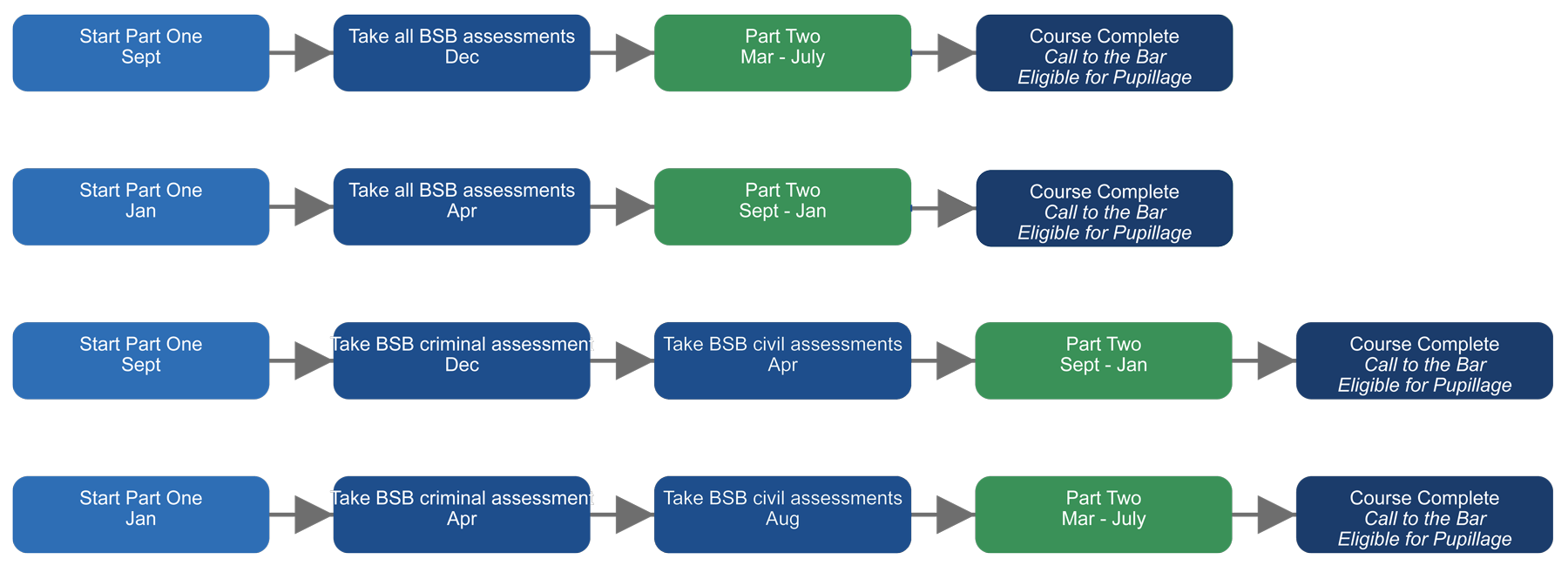
Below you can read more about the commencing Parts One and Two of the ICCA Bar Course towards your goal of Call to the Bar and commencing pupillage. The graphic below provides a helpful overview of these routes. The routes assume you pass your assessments at the first opportunity. Remember that to be called to the Bar you must also complete your Inn’s Qualifying Sessions and pass their ‘fit and proper person’ checks.
Part One Commencement
There are two available commencement dates for Part One, in September and January each year. The earliest Part One commencement dates (for students receiving offers in 2026) are:
- 7 September 2026
- 11 January 2027
Part One Progression
BSB Centrally Set Assessments
On Part One of the ICCA Bar Course you may take the BSB centrally set assessments (Civil papers x 2 and Criminal paper x 1) at sittings in December, April and August. It is possible to take all assessments during one assessment window (e.g. December) or during separate assessment windows (e.g. December and April, or April and August). Both Civil papers must be taken during the same assessment window.
This means that if you commence Part One in September, the first opportunity to sit assessments will be in December. If you start Part One in January, your first opportunity will be in April.
Guided Pathway and Flexible Routes
The Part One course is designed to allow you to follow a guided pathway over 12-14 weeks and to take your assessments at the first available opportunity, should you wish to do so, or alternatively to take a more flexible approach. Bear in mind that if you intend to take all your assessments at the first opportunity, you should treat Part One as you would a full-time job.
The alternative is to take a more flexible approach and spread your assessments over a longer period of time. For example, if you start Part One in September, you may choose to take your criminal paper in December and your civil papers the following April, or if you start Part One in January, you may choose to take your criminal paper in April and your civil papers in August.
This flexible approach is helpful to those of you who have work, caring or other commitments alongside your Part One studies and many of our students take advantage of this option.
Completing Part One within one year
Please note that we recommend completing Part One within one year of commencement. It is also worth noting that students are normally expected to complete the ICCA Bar Course (both Parts One and Two) within 3 years of commencing Part One.
Part Two Commencement
After successfully passing your BSB centrally set assessments, you are eligible to proceed to Part Two of the ICCA Bar Course which commences in either early March (lasting for 17 weeks and completing in July) or early September (lasting for 19 weeks and completing in January).
The earliest Part Two commencement dates (for students receiving offers in 2025) are:
- 2 March 2026
- 7 September 2026
The earliest Part Two commencement dates (for students receiving offers in 2026) are:
- 1 March 2027
- 6 September 2027
Progression to Part Two
To progress onto Part Two you must have completed your Part One BSB centrally set assessments, save in exceptional circumstances. In the table below you can see Part Two commencement and completion dates, as well as when you will need to have passed your Part One BSB centrally set assessments by to be eligible to commence your chosen Part Two course.
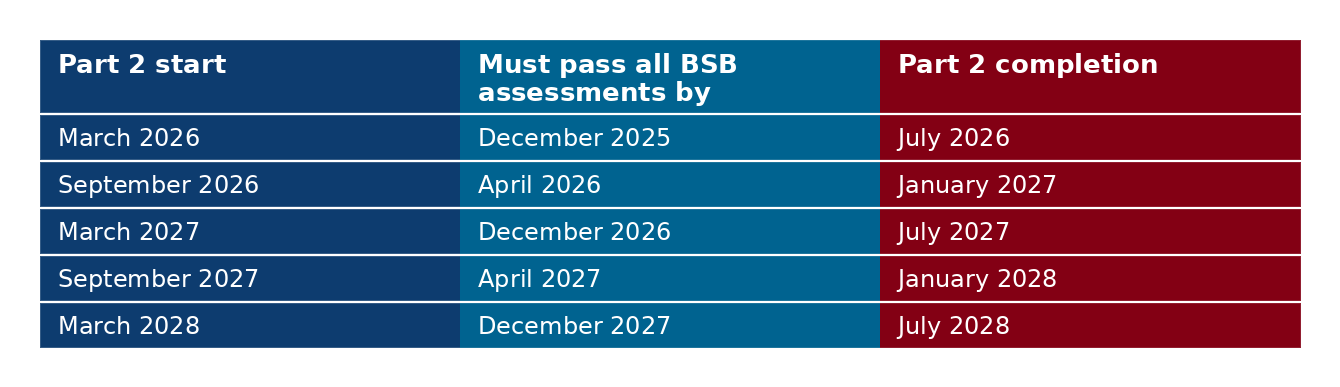
Please note that if you successfully pass your BSB centrally set assessment during the August sitting, the first opportunity to commence Part Two would be in March the following year.
A full-time intensive course
Please bear in mind that Part Two is an intensive, full-time course taught within the Inns of Court in London for which there is an attendance requirement for timetabled classes. Classes are timetabled between 9am to 4pm Monday to Thursday, or Tuesday to Friday for any weeks with a bank holiday on Monday. There is no online-only, hybrid or part-time option for Part Two. Part Two does not therefore have the flexibility of the Part One Course and is not suitable for those who are unable to dedicate themselves to the course throughout its duration and to manage their time effectively.
Joining an Inn of Court
In addition to passing your BSB centrally set assessments, to commence on Part Two you are required to join an Inn of Court, although we recommend that students join their chosen Inn before commencing Part One.
Why might you require a Specific Part Two commencement date?
- If you have secured pupillage, you will require Part One and Part Two commencement dates to ensure that you will be able to commence your pupillage. For example, if you have secured pupillage starting in September/October 2027, you will need a Part One start in September 2026 and a Part Two start in March 2027 (completing July 2027). This would enable you to take all BSB centrally set assessments (civil x 2; criminal x 1) in December 2026. If you are successful, you will then proceed to Part Two in March 2027, completing the course in July 2027. Your Part Two results will be available in good time for pupillage commencement in September/October 2027. Students who have secured pupillage will be given priority for Part One and Part Two commencement (read more about choosing my pathway below).
- You may have secured an Inns’ Scholarship which requires you to complete your Bar course within a specified period of time. In these circumstances, we will prioritise you for a Part 1 and Part 2 commencement date to allow you to complete the course within the required timescale and thus to take full advantage of the scholarship awarded to you.
- If you have a law degree or GDL which will ‘time out’ in December of a given year (usually because they are about to reach their 5-year expiration), we will prioritise you for a Part One start in September (prior to timing out), although you may not require a sequential Part Two start date in March the following year, unless you have pupillage or another good reason to do so.
- If you are applying for pupillage during the ICCA Bar Course (through the Pupillage Gateway in January/February), the vast majority of these pupillages will commence in September/October the following year. For example, if you apply for pupillage in January/February 2027 and receive an offer in May 2027 which you accept, this pupillage will usually commence in September/October 2028. For this reason, you would require a Part Two start no later than March 2028.
We appreciate that there are reasons other than pupillage or scholarships for why you may wish to commence Parts One and Two on particular dates. Please see Choosing Your Pathway below for more information.
Choosing your pathway through the ICCA Bar Course
The ICCA adopts a system to ensure, to the best of our ability, that all students follow the pathway which best suits their needs and requirements. Some students will require Part One and Two commencement dates at the earliest opportunity due to confirmed pupillage places. Others will wish to take a more flexible approach to when they take their BSB centrally set assessments, and thus when they commence their Part Two course.
Provisional Offers – informing us of your preferred pathway
All students who pass the selection process will receive a ‘Provisional Offer’. This informs you that you have passed the selection process. You will then receive a form asking you to specify when you would like to start Part One and when you would like to start Part Two. If you require specific Part One and Two commencement dates, you will be given the opportunity to explain why and provide any documentation in support.
Priority
Priority for requested commencement dates will be given to those with confirmed pupillage offers and scholarships which require you to complete the course within a given timescale. We appreciate that there may be other good reasons why specific dates are required and you will have the opportunity to set these out in your response.
We adopt a timeline for responses to provisional offers to enable students who have applied for pupillage and scholarships to have learnt (in early to mid-May each year) whether or not their application for pupillage or scholarships was successful, and to provide us with proof of this.
Alternatives
Responding to provisional offers allows you to not only inform us of your preferred (sometimes required) commencement dates, but also to let us know if there are alternative dates you would accept if your first choice is unavailable.
Final Offers – assigning you to a designated pathway (the Designated Pathway Scheme)
Once we have received your response, we will provide you with a final offer (usually in early June) in which you will be assigned to specific Part One and Part Two commencement dates. We call this your ‘designated pathway’.
We will endeavour to provide you with your chosen pathway, but this will not always by possible.
Accepting your offer and guaranteed commencement dates
If you accept your offer, your designated commencement dates for both Parts One and Two are guaranteed, unless you subsequently ‘step off’ your designated pathway such that you are no longer able to complete Part One within a timescale which enables you to proceed to your designated Part Two commencement date.
Stepping off your designated pathway
Stepping off your designated pathway will happen when:
- You change your mind and choose to take longer over your Part One studies than you initially intended to. For example, if you are assigned a Part Two start in March 2027 but subsequently decide to delay taking some or all of your BSB centrally set assessments until after December 2026, you would then be outside the timescale for starting Part Two at your designated commencement date.
- You miss a Part One centrally set assessment due to mitigating circumstances and taking the assessment at the next sitting would be outside the timescale for starting Part Two at your designated commencement date.
- You fail one or both of your Part One centrally set assessments and taking the assessment(s) at the next sitting would be outside the timescale for starting Part Two at your designated commencement date. The ICCA permits two resits during subsequent assessment windows.
- You choose not to enrol on your designated Part Two course within the enrolment timeframe provided to you when you are a student on the ICCA Bar Course.
Stepping off your chosen pathway means that the ICCA will no longer be able to guarantee your place on your designated Part 2 commencement date. In these circumstances you will be placed on the next available (as opposed to the next sequential) Part two course after you complete Part One and we will discuss your wishes with you at this time.
However, provided you have passed your BSB centrally set assessments and joined an Inn of Court within a timescale which permits you to progress to your designated Part Two course, your Part Two place is guaranteed.
The 3-year completion rule
Students on the ICCA Bar Course must complete the course (both Parts One and Two) within 3 years of commencement, as required by the ICCA Academic Regulations. This period may be extended in exceptional circumstances by the Bar Course Leader, subject to the BSB requirement that all candidates studying the Vocational Component (i.e. your Bar course) must pass assessments in all subjects within 5 years of the date of enrolment in order to be called to the Bar.
The ICCA will not place any student who steps off their designated pathway onto a Part Two course which would take them outside this 3-year limit, provided the student passes the centrally set assessments within the timescale to enable this. This means that you are always guaranteed a Part Two commencement date within the ICCA 3-year limit provided you pass the centrally set assessments within the timescale to enable this. As mentioned above, this period may be extended in exceptional circumstances, up to a maximum of 5 years from commencement, and should this occur the ICCA will guarantee a Part Two commencement date within this period, provided you pass the centrally set assessments within the timescale to enable this.
After I have chosen my Part Two commencement date, can I change to an earlier date?
You can choose to step off your designated pathway (i.e. your chosen Part Two commencement date), in which case you will be assigned to the next available Part Two course after successfully completion of your Part One BSB centrally set assessments. However, if – after being assigned to your Part Two commencement date – you change your mind and wish to take an earlier Part Two course, we are unable to guarantee that this option will be available to you.
ICCA Bar Course pathways and Pupillage Applications
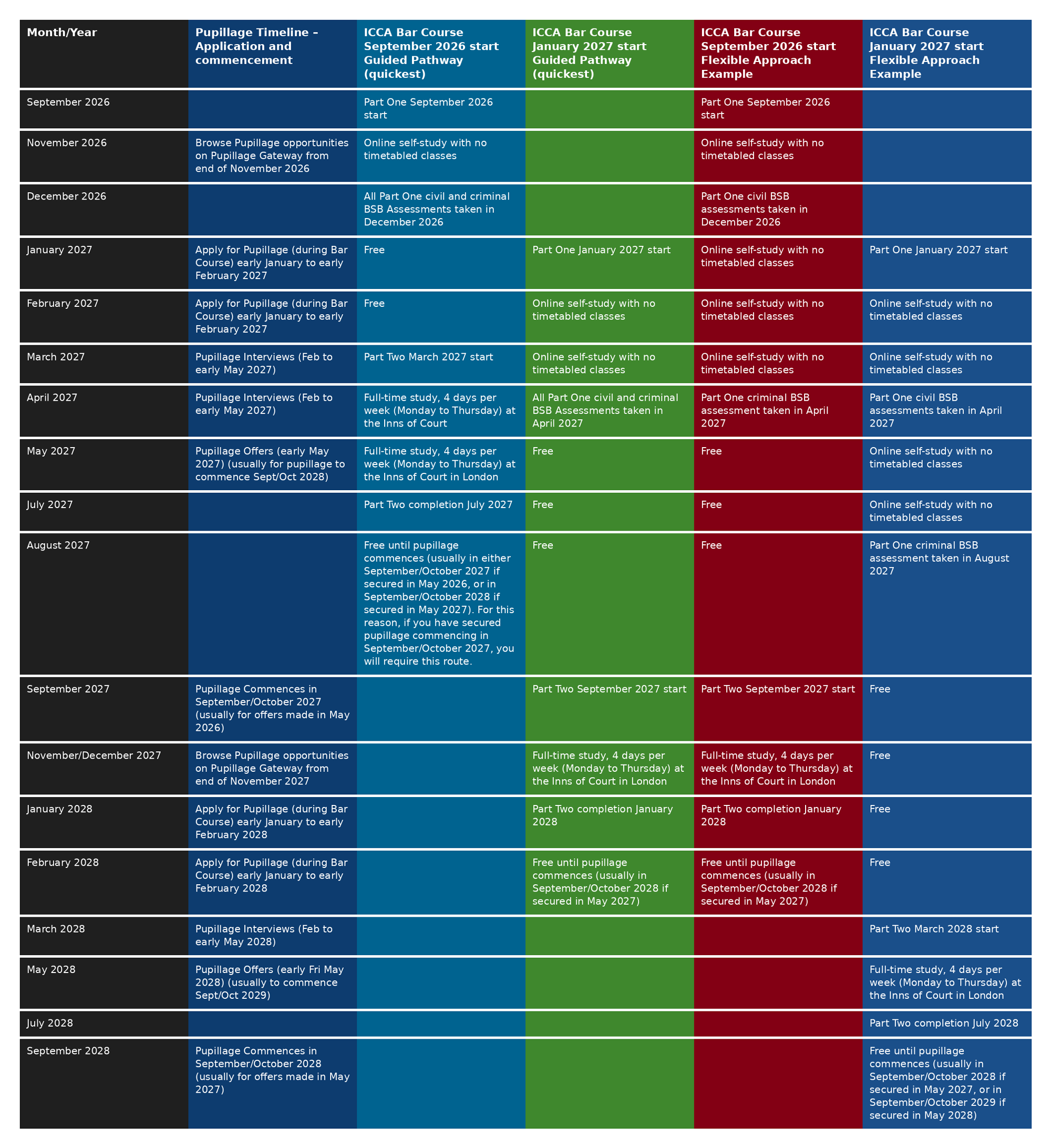
The table below will help you understand how you might choose to progress through the ICCA Bar Course, either by following the guided pathway on Part One or by taking a more flexible approach.
It also reveals when you would apply for pupillage, if you choose to do so during the course. Bear in mind that if you are applying for pupillage during the ICCA Bar Course and you are in the March Part Two cohort, you will have interviews running alongside your studies. This is one considerable benefit of taking your Part Two course in September, in which case you are not undergoing intensive Part Two study at the same time as pupillage interviews are taking place.
ICCA Bar Course Guided Pathway and Flexible Routes
Securing pupillage
ICCA students do exceptionally well in securing pupillage, which stands as a testament to their hard work, enthusiasm and excellent results. The ICCA Bar Course is designed both to be respected by the profession as directly relevant to practice, and to equip you with the knowledge and vital practitioner skills required to achieve success in pupillage and then in professional practice as a barrister.
It is important to bear in mind that there are fewer pupillage/work-based learning places available than there are applicants. Since not all students secure pupillage/work-based learning either before or during their Bar training course, they will continue to apply each following year.
5 years to secure pupillage
Remember that students have a maximum of 5 years after completing their Bar training course to secure pupillage. On the one hand, this is positive news for applicants, since there are many opportunities available after completing your Bar course. On the other, it does mean that a backlog of applicants builds up and it is generally accepted that around 3,000 may be applying each year for around 600 places.
In fact, the Bar Council has reported in its Pupillage Gateway Report 2024 that the total number of pupillage positions advertised through the Pupillage Gateway in the 2022/2023 application window was 638, almost 150 more pupillages on offer than in 2019/20 (489). For these 638 places there were 2,979 applicants.
This demonstrates that competition for places is high and you will need to remain focussed and motivated to succeed, in addition to putting in the hard work required to complete your Bar Course to a high standard.
Pupillage Insights
The Bar Council Pupillage Gateway Report 2024 gives some helpful key insights into obtaining pupillage, taken from the 2022/2023 pupillage application window.
- The biggest indicator of success in securing pupillage was degree classification. 60.1% of offers made were to applicants with a First Class Honours degree. 36.1% of offers made were to those with an Upper Second Class Honours degree.
- Few candidates obtained offers who had not undertaken at least one mini-pupillage: 12.7% of candidates who had attended at least one mini-pupillage received an
offer compared with 1.7% of those candidates who did not. - 53.1% of the 288 offers recorded were received by candidates who had secured a scholarship from one of the Inns of Court, compared with 38.2% of those who did
not. - Students who have not studied law at an undergraduate level are at no disadvantage.
- Most candidates who secured a pupillage (57.3%) had not yet completed the vocational stage of their training.
- A higher proportion of pupillage offers went to women (57.3%) over men (38.9%). This is comparable to 2021/22, where 57.5% went to women and 36.2% to men.
- Of the candidates who received a recorded offer: 60.8% were White (British/English/Welsh/Northern Irish/Scottish); 2.4% were White (Irish); 10.4% were Asian/Asian British; 1.7% were Black/African/Caribbean/ Black British; 10.4% were of mixed ethnicity; 0.3% fell into the other category; and 3.8% preferred not to say.
How to help yourself secure pupillage
There are numerous ways you can help yourself to secure pupillage. After all, you have invested in yourself to take and complete the ICCA Bar Course and to learn new skills which will help you as you progess through your career. What follows is not an exhaustive list, but contains a number of matters you may wish to consider to improve your knowledge, experience and prospects before embarking on a career at the Bar.
Undergraduate Degree Level
It is clear from the Bar Council report above that academic ability is highly prized at the Bar, so obtaining a First Class Honours degree will significantly improve your prospects of securing pupillage. If you have a 2:1, there is no reason to give up now. Remember that there is rarely a ‘perfect’ CV, so read on to find out how else you can improve your prospects.
Mini-Pupillage
It is also clear from the report that your prospects will be improved if you undertake a mini-pupillage.
Mini-pupillages typically last from a few days to several weeks. Some are ‘asssessed’ and are used as an initial method of selecting candidates for pupillage. The key point is that if you are intending to go to the Bar, understanding what life is like at the Bar (including the area(s) of practice you are most interested in) is important. It is vital for you to know that this is what you actually want to do, and it is important for the chambers (or organisation) you are applying to, to believe this is what you want to do, i.e. that you are both motivated and equipped with a good level of knowledge about the profession, chambers and area of practice you seek to enter.
There is no magic number of mini-pupillages you should do, but gaining experience a a chambers you wish to apply to is always useful, as is experience in a chambers that works in the practice area you are interested in.
Advocacy
Advocacy ability is highly prized at the Bar, so demonstrating this ability will be a considerable help.
Taking part (and succeeding) in moots, for example, demonstrates that you enjoy advocacy and are motivated to learn and enhance your skills. The ICCA Bar Course has a considerable focus in Part Two on advocacy, but joining the ICCA Advocacy Committee and taking part in additional advocacy competitions will also help you. In addition, there are numerous advocacy opportunities available, including competitions and additional training with your Inn, a good reason to join an Inn at the earliest opportunity.
Practical advocacy experience can assist you, not least because you can demonstrate to the chambers you are applying to that you have actually represented a client within a legal context. The School Exclusion Project is available (by application) to ICCA students and allows you to represent the parents of children permanently excluded from school. The Free Representation Unit (FRU) enables you to represent clients in certain tribunals, or acting as a County Court Advocate alows you to represent clients at hearings in chambers in the County Court.
Advice Clinics
In terms of practical experience, working in a legal advice clinic will give you excellent hands-on client experience, as well as assisting people in need, and yet again demonstrates a motivation to engage with the sort of work you will be doing in practice.
Solicitors
It is also worth gaining work experience with solicitors who, after all, are responsible for providing the majority of work to the practising Bar. Understanding how solicitors work in practice can be invaluable. Many students work as paid paralegals after completing the Bar course and before commencing pupillage, and this additional knowldge can prove extremely helpful in practice, as well as allowing you to gain contacts within the legal profession.
Careers Help
If you wouild like assistance with your pupillage applications, students on both Parts One and Two can book an appointment with an ICCA Careers Adviser. It is recommended that you go to the Careers Hub (accessed through the VLE) where you will find a wealth of information to help you, and from where you can book your careers appointments. We wish you every success on your journey to pupillage and to a successful and rewarding career at the Bar.
